
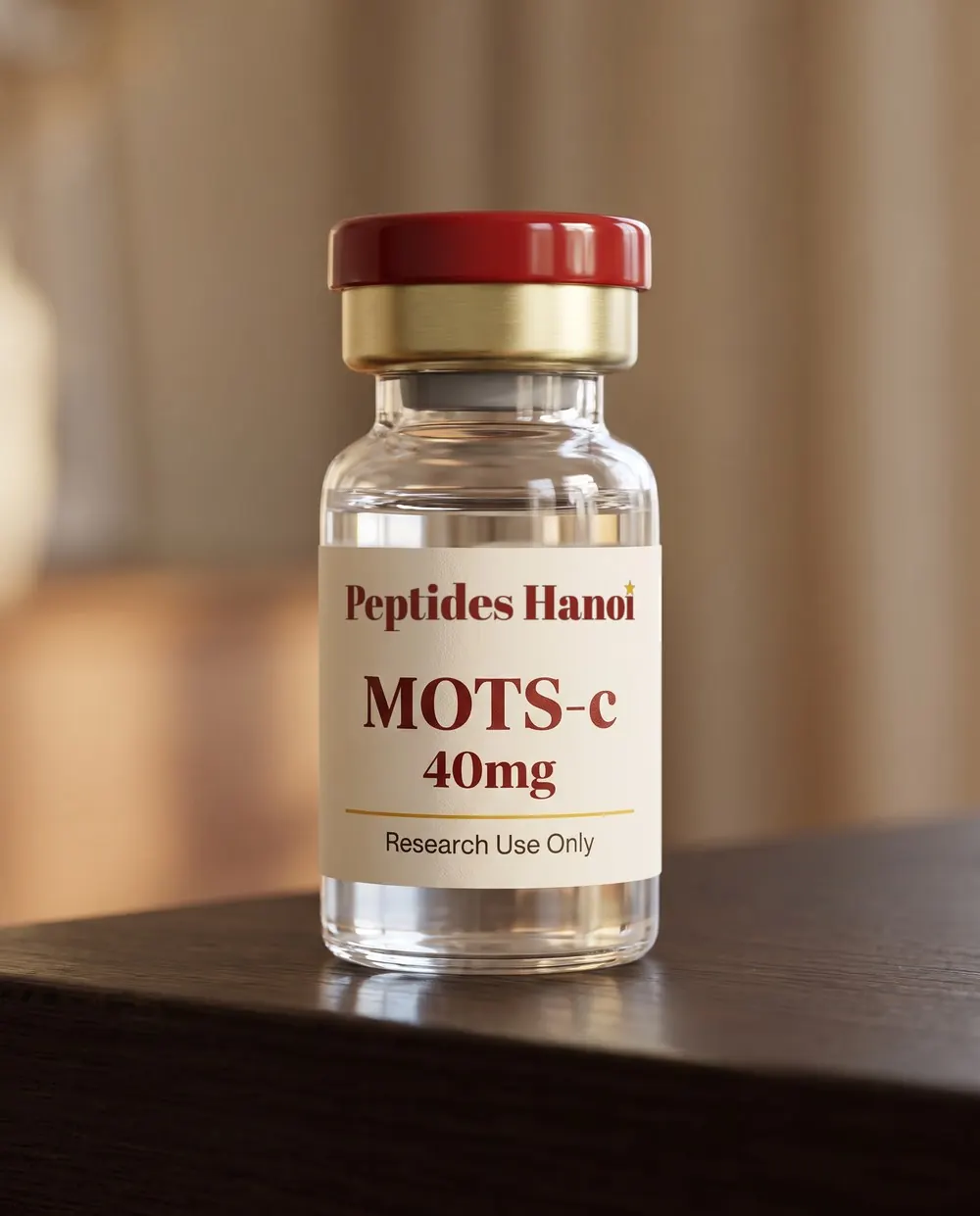
MOTS-c 40mg peptide
MOTS-c 40mg peptide: a research vial of MOTS-c, a 16 amino acid peptide coded in mitochondrial DNA and studied in cells and mice; from its first description in 2015 to a 2021 study of the levels people make during exercise, four MOTS-c papers are linked here.
4,700,000 VND ($185 USD) for 1 vial
Stock and the total are confirmed on WhatsApp.
USD prices are the store's dollar prices; you pay the VND price.
Free tracked delivery to Hanoi in 1 to 3 days, no minimum order. Each vial comes with a bottle of bacteriostatic water and a container. Research use only: not an approved medicine, and no medical advice.
What is MOTS-c?
MOTS-c 40mg is a 16 amino acid peptide written in the DNA of mitochondria. Scientists first described it in 2015, and our search found no trial that has given it to people.
Nearly all proteins are coded in the DNA held in a cell's nucleus. MOTS-c breaks that pattern: its code sits in the separate DNA of mitochondria, the parts of the cell that produce energy.
Its discovery in 2015 started a fresh line of research into how mitochondria signal to the rest of the cell. The field is young, and this entry regards none of it as settled.
What the 4 PubMed papers cited for MOTS-c looked at, 2015 to 2021
Mice on a high-fat diet were the subject of the first paper, in 2015. It measured their fat gain, their response to insulin and where in the body the peptide acted.
In 2018, a cell study followed MOTS-c in cells that ran short of sugar, tracking its move into the nucleus and the genes active there.
In 2021, a study gave the peptide to young, middle-aged and old mice and measured their running and physical ability. A separate study that year measured the natural MOTS-c of 30 people after exercise and saw only a small, unclear rise; none of them received the peptide.
In every study cited here in which MOTS-c was given, it went to mice or cells. The human figure is the body's own level, measured around exercise.
Sources: Cell Metab 2015; Cell Metab 2018; Nat Commun 2021; J Appl Physiol (1985) 2021.
Reading the MOTS-c record
MOTS-c has been a research subject for only about ten years, so its record is short by nature. Work in mice on a high-fat diet does not tell us what happens in people.
The human study adds a useful check: it measured natural MOTS-c after exercise, and nobody was given the peptide.
Read together, the papers sketch a molecule worth watching rather than one whose role is understood.
Questions about MOTS-c
Has MOTS-c been given to people in a trial?
No such trial appears in the record cited here. The one human study measured people's own MOTS-c after exercise.
How is MOTS-c related to humanin?
Both are short peptides coded in mitochondrial DNA. Humanin, next in the list, was found in 2001; MOTS-c in 2015.
What is the difference between MOTS-c and NAD+?
MOTS-c is a peptide of 16 amino acids whose code sits in the DNA of mitochondria. NAD+ is no peptide at all: it is a coenzyme cells use to draw energy from food. Each page here cites its own papers.
MOTS-c 40mg prices
| Pack | Total | Each vial | Per mg |
|---|---|---|---|
| 1 vial | 4,700,000 VND ($185 USD) | 4,700,000 VND ($185 USD) | 117,500 VND ($4.63 USD) |
| Pack of 3 | 11,421,000 VND ($449.55 USD) | 3,807,000 VND ($149.85 USD) | 95,175 VND ($3.75 USD) |
| Pack of 5 | 16,920,000 VND ($666 USD) | 3,384,000 VND ($133.20 USD) | 84,600 VND ($3.33 USD) |
| Pack of 10 | 28,200,000 VND ($1,110 USD) | 2,820,000 VND ($111 USD) | 70,500 VND ($2.78 USD) |
Near MOTS-c in the list of 42
MOTS-c sits between NAD+ 1000mg and Humanin 10mg in the list of 42: three vials tied to the way cells make and manage energy.
- Testagen 20mg, 2,400,000 VND ($95 USD) a vial
- NAD+ 1000mg, 3,800,000 VND ($150 USD) a vial
- Humanin 10mg, 4,700,000 VND ($185 USD) a vial
- SS-31 10mg, 3,000,000 VND ($120 USD) a vial